Interesting Facts About Mars That Make the Red Planet So Fascinating
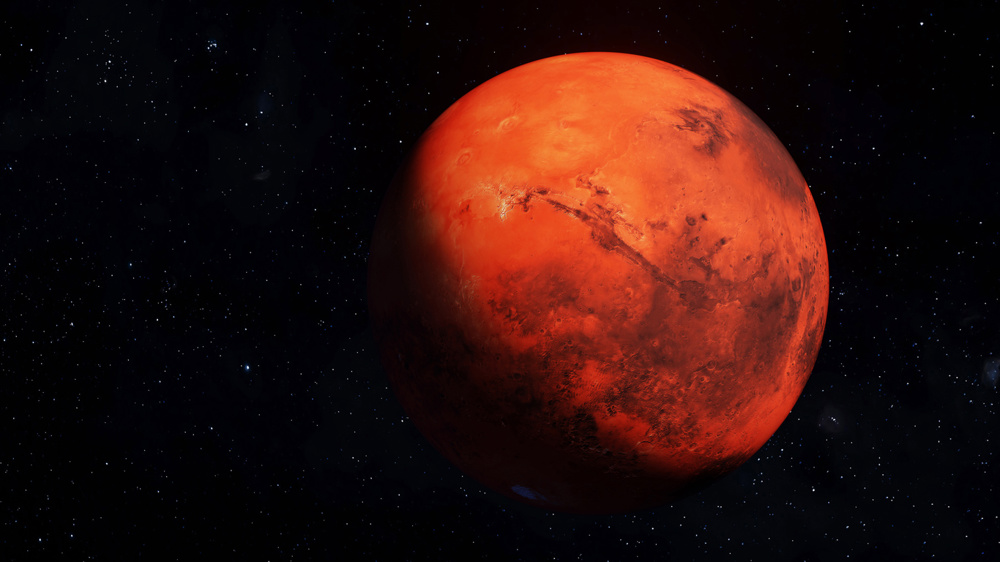
Mars has captured human imagination for centuries, long before spacecraft ever reached its surface. From ancient civilizations that saw it as a symbol of war to modern scientists studying it as a potential second home, the Red Planet sits at the intersection of myth, science, and exploration. Its similarities to Earth—combined with its stark differences—make it one of the most intriguing places in our solar system.
Today, Mars is no longer just a distant point of light in the night sky. It is a world we can map, study, and even explore through robotic missions. With evidence of ancient water, extreme weather systems, and geological features unlike anything on Earth, Mars offers clues not only about its own history but also about the evolution of planets in general. The deeper we look, the more it challenges what we thought we knew.
What Makes Mars the Red Planet?
Mars earns its nickname, the “Red Planet,” from the fine layer of iron oxide—essentially rust—that coats much of its surface. This rust forms when iron-rich minerals interact with oxygen, producing iron (III) oxide (Fe₂O₃), which reflects red light and gives the planet its distinctive color when viewed from space.
Unlike Earth, where weather and water constantly reshape the surface, Mars’s dry and stable environment allows this reddish dust to accumulate and remain visible over vast areas. What makes this even more fascinating is how the dust behaves. Mars has a very thin atmosphere, composed mostly of carbon dioxide, but it’s still enough to lift and circulate fine particles across the entire planet.
During dust storms—some of which can cover the entire globe—this iron-rich dust is suspended in the air, making Mars appear even more uniformly red from a distance. This constant redistribution ensures that its iconic color is not just local but planetary in scale. Recent studies have also identified ferrihydrite, a water-rich iron mineral, as a major contributor to Mars’s red dust. This discovery is important because ferrihydrite typically forms in the presence of water, suggesting that Mars was once much wetter than it is today.
Mars' Weather Is Brutal: Here's Why
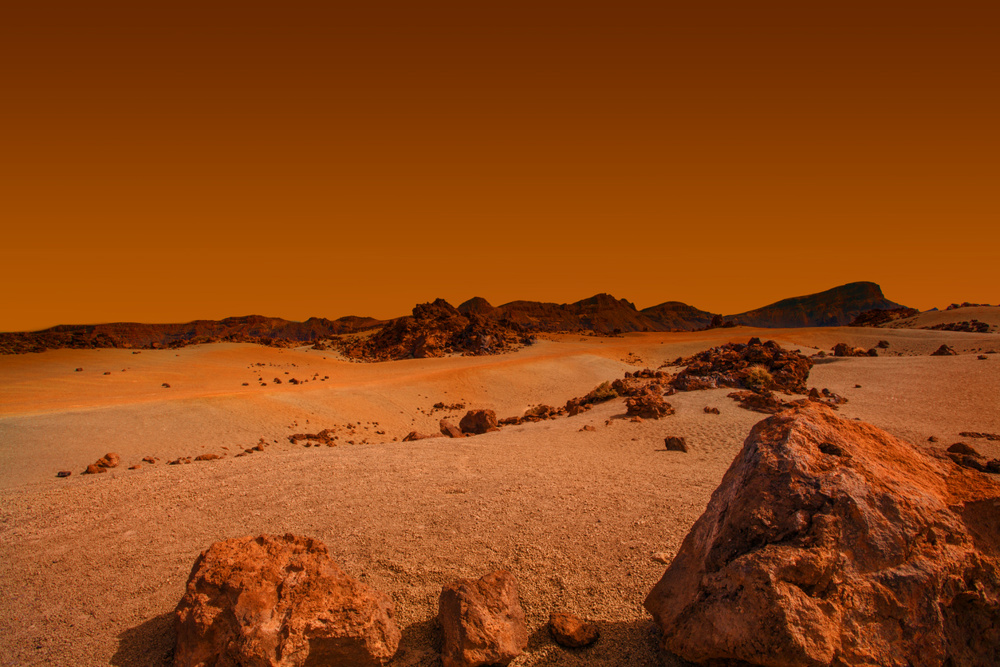
The rust-coated surface that gives Mars its striking red appearance is just one piece of a far harsher picture — the planet's weather is genuinely punishing. You'd face conditions that make Earth's worst storms feel mild:
- Temperature extremes swing from 20°C at the equator to -125°C at the poles.
- Extreme winds reaching 22 m/s lift dry dust into storms lasting months.
- CO2 cycles freeze and sublimate at the poles, shifting atmospheric mass by one-third annually.
- A razor-thin atmosphere — 170 times thinner than Earth's — lets heat escape rapidly, making nights brutally cold.
Global dust storms cool the surface by 20°C while simultaneously warming the upper atmosphere by 30°C, creating wild atmospheric instability throughout the planet. Airborne dust particles absorb sunlight and locally warm the atmosphere, driving winds that lift even more dust in a positive feedback loop that can escalate regional storms into planet-wide events lasting months.
Mars rovers are not immune to these weather effects, though dust devils can occasionally help — a single dust devil cleaning event on Sol 420 restored Spirit's solar array power from a 40% loss down to just 7% overnight. NASA's Curiosity rover, which landed in Gale Crater in August 2012, has directly experienced Mars's harsh environment while traveling nearly 19 miles across its surface and capturing over one million images of its punishing landscape.
Step deeper into the world of science and planets with more fascinating facts and trivia.
Mars's Most Dramatic Surface Features
Beneath its rust-colored sky, Mars hides some of the solar system's most jaw-dropping geological features. Valles Marineris stretches across the planet's surface, showcasing canyon morphology so extreme that its steep-walled valleys and lineated floors reveal billions of years of geological activity. You'll find ridges and grooves along canyon floors that scientists attribute to ancient glacial flow.
Shield volcanism shaped Mars just as dramatically. Olympus Mons, the solar system's largest volcano, towers above surrounding plains and remains visible through telescopes during opposition. Syrtis Major Planum, another shield volcano spanning roughly 1,000 km, consists of basaltic rock formed through ancient eruptions.
Mars also carries 43,000 documented craters, preserved remarkably well thanks to the planet's stable crust, minimal tectonic activity, and low erosion rates. The presence of hematite and goethite across certain regions of the Martian surface strongly suggests that liquid water once flowed there in the distant past.
Did Mars Ever Have Water?
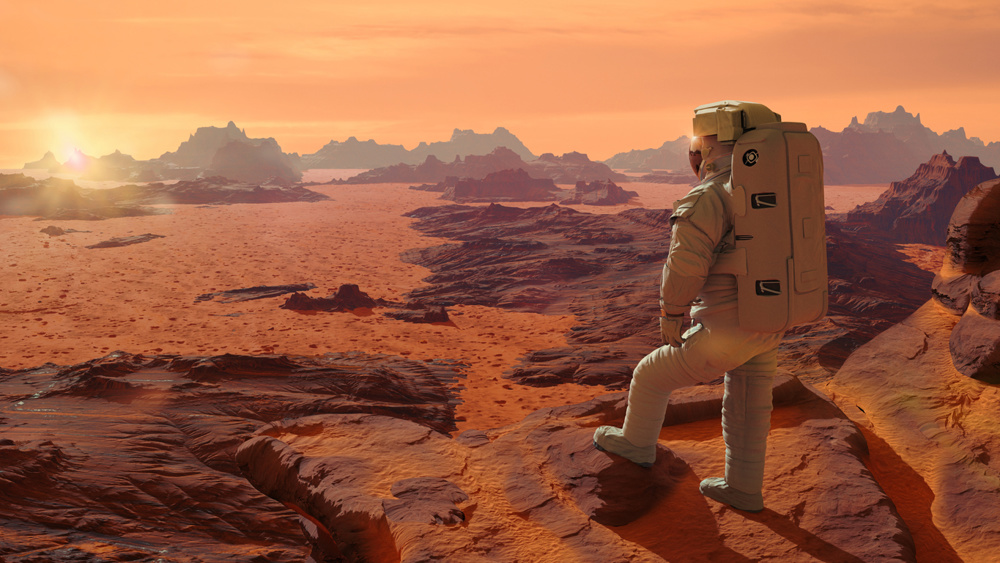
Once a world of rivers, lakes, and possibly vast oceans, Mars holds compelling geological evidence that liquid water once flowed freely across its surface. NASA rovers confirmed persistently wet environments in 2004, while deuterium levels eight times Earth's suggest enormous ancient water volumes. Today, subsurface reservoirs hold water 11.5–20 km deep, enough to cover Mars 1–2 km deep.
Here's what the evidence reveals:
- Ancient oceans likely covered one-third of Mars's northern hemisphere
- Hematite "blueberries" formed exclusively in watery conditions
- Hydrated clays and sulfates lock in proof of past surface flow
- Subsurface reservoirs detected by InSight's seismic data remain potentially habitable today
Ultraviolet sunlight splits surface water into hydrogen and oxygen, gradually stripping Mars's once-abundant water away. The deep reservoir resides in fractured, porous igneous rock, making it inaccessible with current drilling technologies despite its enormous estimated volume. Much like how electron degeneracy pressure ultimately fails beyond a critical threshold, Mars's ability to retain surface water collapsed once its magnetic field weakened and solar winds stripped away its protective atmosphere.
Why Humans Should Explore Mars First
Mars stands out as the most realistic and scientifically valuable destination for human exploration beyond Earth. While robotic missions have provided incredible insights, they are limited in speed, adaptability, and decision-making. A human explorer could accomplish in hours what a rover might take weeks to complete, especially when responding to unexpected discoveries.
The scientific potential alone is enormous. Discovering even simple microbial life on Mars would fundamentally change our understanding of biology and our place in the universe. It would answer one of humanity’s biggest questions: Are we alone? Humans on the surface would be better equipped to identify subtle signs of life and conduct complex experiments in real time.
Mars also offers practical advantages for long-term exploration. It has accessible water in the form of ice, a day length similar to Earth’s, and resources that could potentially support human habitation. Technologies such as oxygen extraction from the Martian atmosphere are already being tested, laying the groundwork for future missions.
Why Mars Is the Center of Modern Space Exploration
Mars has become the focal point of modern space exploration because it represents the most achievable step beyond Earth. It sits at a unique intersection of accessibility and scientific value—far enough to challenge current technology, yet close enough to be reached within months rather than years or decades.
Compared to planets like Jupiter or Saturn, Mars offers a realistic target for both robotic and human missions, making it the logical next frontier. This balance has drawn global attention. Space agencies such as NASA, ESA, and CNSA, along with private companies like SpaceX, are all actively developing missions focused on Mars.
Rovers like Perseverance are not just exploring—they are preparing for future human arrival by testing technologies such as oxygen production and collecting samples that may eventually be returned to Earth. Each mission builds on the last, creating a continuous chain of progress rather than isolated achievements.
How Mars Influences Pop Culture and Imagination
Mars has long occupied a powerful place in human imagination, serving as both a scientific curiosity and a storytelling canvas. Its Earth-like qualities—day length, seasons, and surface features—make it easier to imagine as a place where life could exist or where humans might one day live. This familiarity, combined with its stark differences, makes it ideal for exploring “what if” scenarios in creative works.
From early science fiction novels like The War of the Worlds to modern films such as The Martian, Mars has been used to explore themes of survival, isolation, and discovery. It often represents the unknown—close enough to feel real, yet distant enough to allow creative freedom. In many stories, Mars becomes a mirror for human challenges, reflecting fears about technology, environment, and the future.
The planet’s influence extends beyond film and literature. Video games, music, and visual art frequently incorporate Martian imagery, reinforcing its role as a cultural symbol. Red landscapes, futuristic colonies, and space travel narratives have become recognizable motifs that audiences instantly associate with Mars.
Could Humans Really Live on Mars?
The possibility of humans living on Mars has shifted from speculation to active research. Scientists and engineers are now focused on solving the practical challenges of survival on the planet, including exposure to radiation, reduced gravity, and limited access to essential resources.
One of the key areas of development is in-situ resource utilization—using materials already present on Mars to support human life. Technologies are being tested to extract oxygen from the carbon dioxide-rich atmosphere, melt water from ice deposits, and grow food in controlled environments. These systems are essential for reducing dependence on supplies from Earth, which would be costly and difficult to maintain.
However, significant obstacles remain. Mars’s thin atmosphere offers little protection from solar radiation, requiring habitats to be shielded or built underground. The lower gravity—about 38% of Earth’s—raises questions about long-term effects on human health. Additionally, the journey itself takes several months, posing risks related to isolation, limited medical support, and psychological stress.
Conclusion
Mars is more than just a neighboring planet—it is a window into the past and a possibility for the future. Its red surface tells a story of transformation, from a once wetter world to the harsh environment we see today. Its geological features reveal immense forces at work, while its history of water raises questions about life beyond Earth.
At the same time, Mars represents ambition. It is where science, technology, and imagination converge, driving exploration and inspiring new generations. Whether as a subject of study or a destination for future missions, Mars continues to challenge and expand our understanding of what is possible.